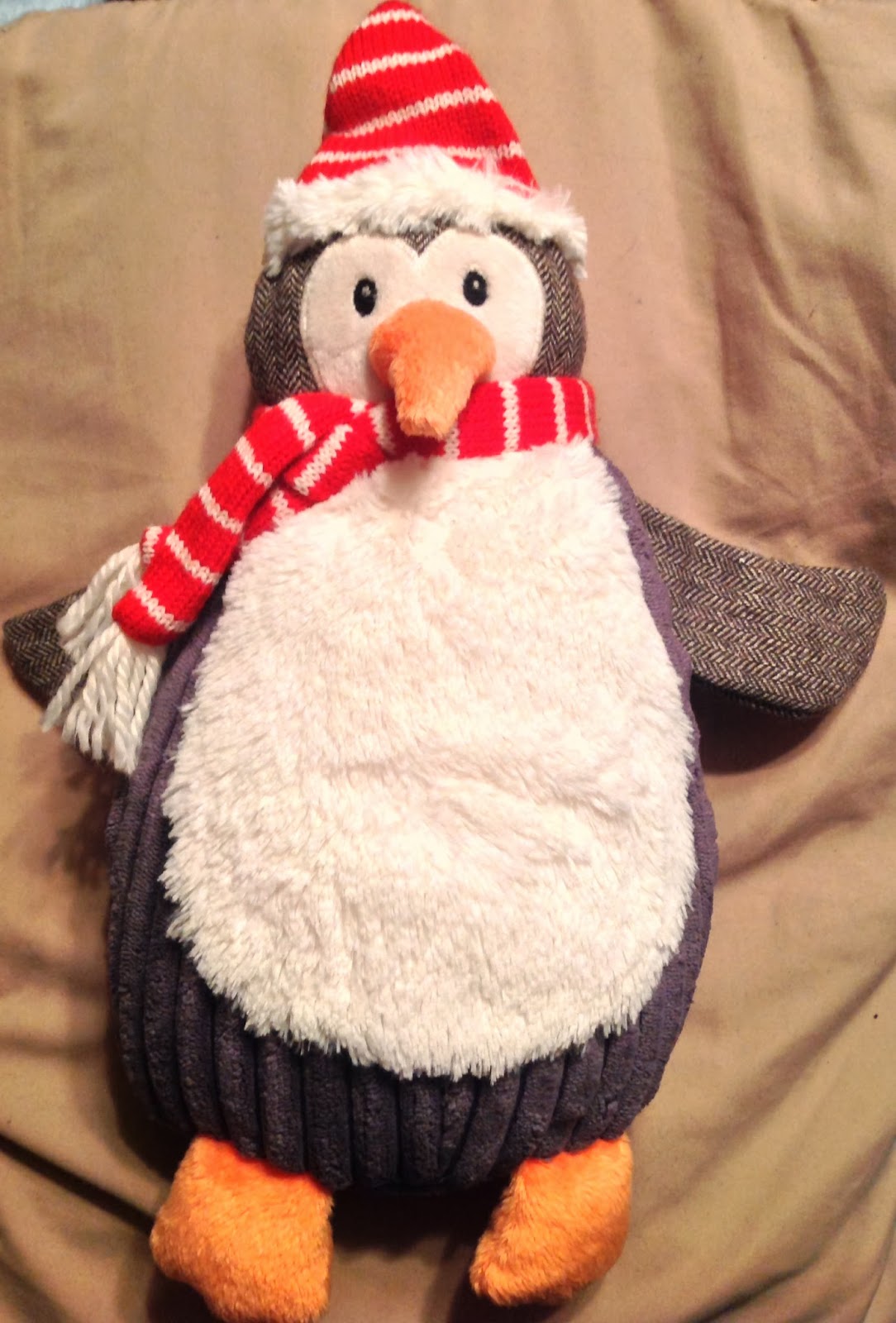
I call him Pepe (like Pepe the King Prawn from The Muppets) the Penguin. He's been a great little muse this afternoon, something to fiddle with with one hand while I edited with the other. I love penguins so he's a perfect addition to my little stuffed animal collection. I'm a very tactile person - I learn kinesthetically and I love different textures and fabrics, especially super soft things like silks and microfiber blankets. I have two micro raschel blankets I absolutely love to snuggle under because they're so soft and soothing (One is Deadpool and the other is the TARDIS in case you were wondering). Anyway, many welcomes from me to my little Pepe mascot. Just a random, little girly type thing that made me happy today. I've been having a little bit of a rough couple of weeks so even though it may seem childish my penguin makes me happy and I thought I'd blog about it. Anyway, Pepe and I are off now, looking for some eggs.
Saturday, January 4, 2014
January Challenge Day 3
Today I edited 26 pages of my novel, Slayer, and wrote 575 words in my YA fantasy novel, The Land of Faiyan. I've been doing all of this with a raging sinus infection so I'm pretty pleased with myself. I also figured out it takes about two handwritten pages on my cute legal paid (it has pink plaid at the top which makes it cute) to equal five hundred words in my word processor. It's nice to have some sort of idea where I'm at with my goal when I'm handwriting. Even better for my OCD, I managed to end this session of writing not only at the end of a section in the story but also at the end of a page. Sweet! In other news, I got to get out of the house for a little bit today with a good friend. We went to a local boutique market - a bunch of vendors share booth space in one large store - and I picked up a new writing mascot.
Friday, January 3, 2014
Challenge Day 2
Day two of my challenges and I have met my goal! Actually, I exceeded it by 189 words. I'm very happy with that, even though I'm not quite up to the 1-2k per sitting I used to crank out. This feels good, though, I feel my creativity stretching and waking up again, even though I feel like it dries up more quickly than it once did. In addition to the new section in my YA novel, I also edited nineteen pages of my sci-fi novel. This was much better than I have done the last two days trying to edit. I think the difference is, I printed my novel and edited by hand with my favorite purple felt-tip pen. I also made sure yesterday that my YA novel was at a clear stopping point/section end so I could easily begin handwriting it instead of typing directly into the computer. As soon as I got going with my purple pen (All hail the mighty purple pen. Hail!) again, the ink flowing onto the paper, it was like my brain woke back up and shook the cobwebs and rust off of a part of itself I was afraid I no longer knew how to access. As a matter of fact, I knew that I was close to making the 500 word goal for today, based on what I'd already typed into the computer, but the scene and the words would not stop flowing and I literally (Yes, literally.) could not stop writing. It felt so good to have ideas flowing like that again, to hear what the characters were saying and writing as quickly as possibly to transcribe their words from my mind's eye to the paper. I have always handwritten all of my work first and I loved that part of my writing process. It's such an organic experience, watching and feeling the words flow from my brain through my arm and my hand to the pen and onto the paper. I write in cursive, as well, which adds something to the smooth, flowing process of the writing. That's why I'm so picky about my pens, I think. I absolutely cannot have a break in ink flow - it destroys my entire train of thought, throws off my concentration, and my relaxation in the flow is gone because there is no flow - it's been interrupted by the skipping ink of the faulty pen. This, though, today, felt like magic. I think when I first started back into this on New Year's Day, that was part of the problem. I was coming back to electronic manuscripts - a novel that needed edited and another that had already been transcribed from notebook to computer. They felt like foreign pieces to me. I didn't recognize them as my own works. I couldn't connect with my stories or my characters - a lack of connection I felt most strongly in my YA novel. It was like the ink was skipping. Once I had the stories back in my hands, could touch the paper and let the words flow freely, uninterrupted by keyboards and computer screens and word processor spacing errors, I felt free again. I felt like me again. I felt my characters again. I remembered what I was so impassioned about with this YA novel, where I wanted to take it, came up with new ideas for it. No, I didn't write as many words today as I used to, but I think, for the experience alone, these were some of my favorites I've written.
Thursday, January 2, 2014
Motivation
It seems I felt I needed a lot of motivation for this first month back at writing. Not only have I signed up for the January writemotivation.org plan, I also signed up for the My 500 Words thirty-one day challenge. With this challenge, I am supposed to write at least five hundred words every day. I'm excited about this challenge - I think it will help me set a steady routine and keep myself focused on my goals I set for Write Motivation. This is a really short post since I only have a few minutes but I may post again this evening with an update on how I've done with my first day of writing challenges and goals. Excelsior to me, as Stan Lee would say. I'm definitely going to need some energy to get through this, though. Maybe I need some eggs.
Wednesday, January 1, 2014
"I'm back, baby dolls!"
Yes, the title of this post is an HIMYM quote. No, I don't go around randomly calling people "baby dolls." But I digress.
It's been a long time since I've blogged about writing or did any writing for that matter. Because reasons. I'm back now, though, and I'm enjoying creating and editing again. I'm prepping my first novel for self publication and I have several other projects I'm working to complete and prep for publication. To help keep myself motivated, I just signed up at writemotivation.org for the month of January. My three goals:
1. Finish final editing on my novel in prep for publication.
2. Finish the rough draft of my YA novel.
3. Add to the rough draft of my novel's sequel - I want to go from 1/3 complete to 1/2. It depends on where I decide to end the sequel, I may be moving from 1/2 to 2/3. At any rate, I just want to add to it.
According to the site, I need to blog once a week to update on my progress with my goals. So, this is me, with my inaugural post for the new year. Not that imaginative, not that long, but it's a post, it's writing, so I say it's good.
Now if only my aching head and clogged sinuses and sore throat would stop making me so miserable I can't focus on anything except how much my head aches and how clogged my sinuses are and how sore my throat is. Maybe I need some protein. Eggs. Somebody pass me some eggs.
It's been a long time since I've blogged about writing or did any writing for that matter. Because reasons. I'm back now, though, and I'm enjoying creating and editing again. I'm prepping my first novel for self publication and I have several other projects I'm working to complete and prep for publication. To help keep myself motivated, I just signed up at writemotivation.org for the month of January. My three goals:
1. Finish final editing on my novel in prep for publication.
2. Finish the rough draft of my YA novel.
3. Add to the rough draft of my novel's sequel - I want to go from 1/3 complete to 1/2. It depends on where I decide to end the sequel, I may be moving from 1/2 to 2/3. At any rate, I just want to add to it.
According to the site, I need to blog once a week to update on my progress with my goals. So, this is me, with my inaugural post for the new year. Not that imaginative, not that long, but it's a post, it's writing, so I say it's good.
Now if only my aching head and clogged sinuses and sore throat would stop making me so miserable I can't focus on anything except how much my head aches and how clogged my sinuses are and how sore my throat is. Maybe I need some protein. Eggs. Somebody pass me some eggs.
Wednesday, October 20, 2010
Good News is Bad News
That's right, I said it (typed it). You don't want the good news. It's horrible and of no help to you whatsoever.
At least, that is, when it comes to your story.
Now, yes, you definitely want to get some sort of positive feedback on your story. It's important to hear that your beta readers are connecting with your characters, enjoying your plot, and all that jazz (If you don't care for jazz, you can substitute your favorite genre here, hip hop, rock, alternative, country, what have you). While you are still mid-project, however, taking in feedback in order to improve your work, good news is only so good.
From first draft to ready for submission, you have to be ready to tear your story apart. I know, it's your baby and reworking plot, killing a character, changing the opening line, or cutting dialogue, makes you feel like you're living out "A Modest Proposal" (It's by Jonathan Swift, go read it). All you really want to hear from your beta readers is how much they loved the story, how fabulous your characters are, and you shouldn't change a thing because it's all perfect.
No, it's not.
It's not perfect and that's not all you want to hear and you and I both know it. In all of our works, there is always room for improvement. Dialogue can always be tweaked, character can always be deepened, conflict can always be increased, and syntax can always be adjusted. We strive to make every change in our works changes for the better. Writing is rewriting. It's an oft-repeated adage and that's because it's true. It's why you don't send an agent or an editor your first draft (Good heavens. The very thought of sending in my first draft is embarrassing.) Okay, so we all agree that our work is never perfect (Unless of course you're sitting there saying, "Are you crazy? All of my work is always perfect! The first time around, to boot!" in which case we don't agree at all and in fact very strongly disagree on several different levels but not one of which is my sanity.) but what do I mean when I say that we don't want to hear about how great our stories are? I'm getting there. I know it may not seem like it but I am. In fact, I'm getting there right now.
No, seriously, I am.
If your beta readers have nothing but good things to say about your work, they're not good beta readers. The point of a beta reader is to help you work out all of the kinks in the system, find the bugs, the flaws, search and destroy, shock and awe! (Sorry, carried away. I like explosions. Part, but not all, of the reason my sanity is never questioned. My mother didn't have to have me tested. Bazinga.) Are you giving your book to the your best friend Mary Sue (A huzzah to you if you get the reference.) who never has an unkind, critical, or opinionated word to say about anyone or anything? News flash: Mary Sue is not a good beta reader. All Mary Sue will do (Dr. Seuss jokes may be inserted here.) is tell you sweet nothings about how much she loved your story and it's fantastic just the way it is. As flattering as that is, and as great as it feels to hand your manuscript out to a dozen Mary Sues and receive such feedback at every turn, I have one question for you.
How are you going to improve off of positive feedback?
By the time you've passed your manuscript off to beta readers, your brain probably starts oozing out your ears every time your look at those double-spaced pages. You need beta readers to catch what your revision-wearied eyes are missing. A beta reader should be looking critically at your characters, your plot, your sentence structure, everything.
Now, when I say "critically" I'm not talking about unkind criticism. Completely negative early reviews are just as horrible as completely positive ones. I'm talking about the type of criticism that approaches a work with a critical eye, ready to praise and evaluate both honestly and objectively.
These are the type of beta readers you need to seek out. Friends are fine, but they had better be friends who aren't afraid to share their opinions with you. A good beta reader will tell you that plot point B does not follow plot point A and your main character is great but his/her love of My Little Pony doesn't jive with that daytime job as a gumshoe. See what I'm talking about? Yes, your beta reader should encourage you and praise what you are doing well. That's motivation to keep writing and a morale booster at the end of a long, hard journey to complete a story. A good beta reader should also tell you where improvements can be made; an outside perspective will see things you didn't and your story will wind up being that much better because you had a helpful beta reader.
One final note: take your reader's comments with a grain of salt. This is still your work. I have ignored as many suggestions as I have taken to heart and I've never been sorry. I only offer my stories to readers I know and trust to help me make my story as wonderful as possible but at the end of the critique session I am still the writer. I know my story and I am the only one who can make the final decision. To be fair to my work, I try to approach the story with the same honesty and objectivity I have asked of my beta reader. I come back to the story ready to rip it to shreds if that's what is needed. Most of the time, it doesn't come to that, but with that attitude prepared, I am ready to absorb all of the suggestions my beta readers have and work them into my story so the end result is something I would be proud to send to an agent or an editor.
Look for a beta reader who is kind enough to be honest, even when the truth is going to hurt a little (or a lot, let's keep going with the honesty theme). Mary Sue is your enemy when it comes to this part of your writing process. You've put so much into your manuscript; don't skimp on the final steps before submission. You and your story deserve the best beta readers available. Mary Sue isn't it.
I'd love to hear from you! What do you look for in a beta reader? Care to share some of your good and/or bad beta reader experiences? Go ahead and tell on Mary Sue, it's okay.
Thursday, October 7, 2010
Influenza Type A
I did some research online, and apparently the H1N1 virus is a subset of Influenza Type A, which, just so you know, is the strain of the influenza virus responsible for the most epidemics and is the worst type of flu to have.
I have the flu, by the way.
And yes, it's Type A.
Woohoo.
I've never had the flu before and have never had a flu shot. That's the only benefit of actually having the virus apparently -- being sick builds up a better immunity than the shot itself. So the aches and nausea and misery and fatigue are the trade off for a sharp piece of metal being jabbed into my fibromyalgia-tightened muscles.
I'll take what I can get.
As I was tossing and turning and tossing and turning and tossing and turning ad infinitum or didn't you get that already because I could keep going with the tossing and turning and tossing and turning bit I did come up with a way to get something else out of the flu besides salvation from said painful shot.
Do unto your characters as you would not have done unto you. Book of Fey 1:1.
That's right, I'm going to give them the flu. I know it seems cruel, but from where I'm laying (Lying? I never know. One grammar point that always confuses me. I will say this, just as a grammar pet peeve: you're not going to "try and" do anything. Think about it.) somebody else should be suffering as much as I am and as I'm not into inflicting pain and misery onto my fellow human beings in such a manner I might as well do it to my fictional characters.
Seriously, though. (Yes, it's a fragment. Those are allowed outside of term papers. Laying? Lying? Doesn't come up as often when writing about Milton's Raphael narrator versus Milton's Michael narrator. Although technically, that was a blue book essay, not the term paper. The term paper was just about the Raphael narrator. I don't know why they have to be blue books. I wouldn't discriminate against green books. And frankly, I think purple books would just make us all cheerful when we sit down to write an in class essay that counts for a third of our grade and we haven't even read the book. Maybe it's the alliteration. Blue book. That's a poetry lesson for you. Wait. Stop. I got lost. Stupid flu.) Smooth sailing is the death of your story as my screenplay professor used to say. When in doubt increase the conflict. Don't give your characters an easy way out. Make them work for everything they have to have, even if it's just a vanilla latte the character is trying to get on the way to work. Throw some traffic in there, a wayward bicyclist, something. Think about the was The Proposal used this at the very beginning of the movie. All Andrew Paxton wants is to get a cup of coffee and make it to work on time. He gets there, yes, but he had to work for it, switching shirts with a co-worker, giving up his coffee cup with the cute barista's phone number, and so on. Conflict. Drama. Stress. Letting the audience know that it is really important for this character to get to work on time with this coffee. Hints about what his work life is like. And guess what, poor Andrew's troubles don't end there. His boss figures out his deception and knows that he orders the same coffee she does just in case he spills hers. Which he did.
Would any of us want this done to us? I wouldn't want to live through that crazy morning. Neither do your characters, but guess what (yes, again, it's repetitive, but I'm sick and not into editing but I am into excuses) it's good for them. Conflict builds character. (hardeeharharhar.) Give your characters the flu. Turn off the alarm clock. Make them late for work. Rush hour traffic. Thunderstorms while walking into the wedding chapel. Car accidents. Wayward bicyclists (I don't know why, it's just funny.). Whatever, but make your characters work for whatever they are trying to accomplish in your story. Don't take the second cousin's rich great uncle died and left a bunch of money in the will option. That's a cop out. It should never be easy. Smooth sailing is the death of your story. When things get easy it's not fun anymore. There's no reason to root for anyone when there's nothing to fight. Deepen the conflict.
When in doubt, send two men through the door with guns.
Or just send in the flu. Type A is best.
(Laying? Lying? Milton's angels, that's all I know.)
I have the flu, by the way.
And yes, it's Type A.
Woohoo.
I've never had the flu before and have never had a flu shot. That's the only benefit of actually having the virus apparently -- being sick builds up a better immunity than the shot itself. So the aches and nausea and misery and fatigue are the trade off for a sharp piece of metal being jabbed into my fibromyalgia-tightened muscles.
I'll take what I can get.
As I was tossing and turning and tossing and turning and tossing and turning ad infinitum or didn't you get that already because I could keep going with the tossing and turning and tossing and turning bit I did come up with a way to get something else out of the flu besides salvation from said painful shot.
Do unto your characters as you would not have done unto you. Book of Fey 1:1.
That's right, I'm going to give them the flu. I know it seems cruel, but from where I'm laying (Lying? I never know. One grammar point that always confuses me. I will say this, just as a grammar pet peeve: you're not going to "try and" do anything. Think about it.) somebody else should be suffering as much as I am and as I'm not into inflicting pain and misery onto my fellow human beings in such a manner I might as well do it to my fictional characters.
Seriously, though. (Yes, it's a fragment. Those are allowed outside of term papers. Laying? Lying? Doesn't come up as often when writing about Milton's Raphael narrator versus Milton's Michael narrator. Although technically, that was a blue book essay, not the term paper. The term paper was just about the Raphael narrator. I don't know why they have to be blue books. I wouldn't discriminate against green books. And frankly, I think purple books would just make us all cheerful when we sit down to write an in class essay that counts for a third of our grade and we haven't even read the book. Maybe it's the alliteration. Blue book. That's a poetry lesson for you. Wait. Stop. I got lost. Stupid flu.) Smooth sailing is the death of your story as my screenplay professor used to say. When in doubt increase the conflict. Don't give your characters an easy way out. Make them work for everything they have to have, even if it's just a vanilla latte the character is trying to get on the way to work. Throw some traffic in there, a wayward bicyclist, something. Think about the was The Proposal used this at the very beginning of the movie. All Andrew Paxton wants is to get a cup of coffee and make it to work on time. He gets there, yes, but he had to work for it, switching shirts with a co-worker, giving up his coffee cup with the cute barista's phone number, and so on. Conflict. Drama. Stress. Letting the audience know that it is really important for this character to get to work on time with this coffee. Hints about what his work life is like. And guess what, poor Andrew's troubles don't end there. His boss figures out his deception and knows that he orders the same coffee she does just in case he spills hers. Which he did.
Would any of us want this done to us? I wouldn't want to live through that crazy morning. Neither do your characters, but guess what (yes, again, it's repetitive, but I'm sick and not into editing but I am into excuses) it's good for them. Conflict builds character. (hardeeharharhar.) Give your characters the flu. Turn off the alarm clock. Make them late for work. Rush hour traffic. Thunderstorms while walking into the wedding chapel. Car accidents. Wayward bicyclists (I don't know why, it's just funny.). Whatever, but make your characters work for whatever they are trying to accomplish in your story. Don't take the second cousin's rich great uncle died and left a bunch of money in the will option. That's a cop out. It should never be easy. Smooth sailing is the death of your story. When things get easy it's not fun anymore. There's no reason to root for anyone when there's nothing to fight. Deepen the conflict.
When in doubt, send two men through the door with guns.
Or just send in the flu. Type A is best.
(Laying? Lying? Milton's angels, that's all I know.)
Wednesday, September 15, 2010
Writing a Poem is Like Opening a Window
Writing a poem
is like opening a window
and letting fresh air
rush through a hot
stuffy room.
The air so thick it
stifles and strangles.
The hot breath of the
room reaching its thick
muggy fingers up your
nose
and into your brain preventing
all thought. You
can't even breathe be-
cause the air's in your lungs
and wrapped around your
chest crushing you and
trapped you flail about for
the window
Frantically
raise the glass
lean forward and
inhale, mouth
open,
something clear, cool, and clean.
Monday, September 6, 2010
Villanelle
The villanelle is a poetry form based on repetition.
Aquarium
I like watching
the fish in the aquarium
watching them glide by
bright colors silent
sovereign in my eye
I like watching
the sparkle flashing by
light through water, shadows playing
watching them glide by
the best is walking underneath
like I am one of them
I like watching
heavy motion, effortless
fly by the plexiglas, leaving me behind
watching them glide by
I love the life, the beauty there
the untouched and serene
I like watching
watching them glide by.
Aquarium
I like watching
the fish in the aquarium
watching them glide by
bright colors silent
sovereign in my eye
I like watching
the sparkle flashing by
light through water, shadows playing
watching them glide by
the best is walking underneath
like I am one of them
I like watching
heavy motion, effortless
fly by the plexiglas, leaving me behind
watching them glide by
I love the life, the beauty there
the untouched and serene
I like watching
watching them glide by.
Monday, August 30, 2010
Vices
Reading life too much,
Loving things too much,
Holding on so hard it hurts,
Wanting my own way too much,
Demanding
All I want from
Love and life and happiness and
God,
Screaming in my head too much,
Ignoring peace in silence.
Loving things too much,
Holding on so hard it hurts,
Wanting my own way too much,
Demanding
All I want from
Love and life and happiness and
God,
Screaming in my head too much,
Ignoring peace in silence.
Monday, August 23, 2010
Sometimes I Dream in Faerie Tales
Sometimes I dream in Faerie tales.
Not "fairy tales" but
Faerie tales.
Not idealistic Disney dreams about
Prince Charming and
happy all the time.
Not the fake, simplified spelling of
"fairy" but the
complicated devastating world of
Faerie where not everything is
Black and white and easy fixes.
A Faerie tale is a tale of Faerie.
Of Faerie separated from our world.
Where humans love the Faerie girls
who have no reason to love them back
again.
Of Selkies who will always leave.
Of the Fey who never stay.
A place outside our understanding,
Mortal limits, and our time.
Sometimes I dream in Faerie tales,
Where happy endings are rarely written
But where the truth resides.
The truth of love that conquers all.
If only for a time.
The truth of courage and of wit.
The love of nature and the loss of human
pride.
Sometimes I dream in Faerie tales.
One day I won't wake up.
1/28/10
Monday, August 16, 2010
Missing
Somehow
it's the family members who aren't there
that seem to
define you
Even more than
the ones who still breath in and out
beside you every day
The single mother
Child sans a father
Brother who's an only child
Read beyond the lines and
look between the photographs
what isn't there
Defines.
it's the family members who aren't there
that seem to
define you
Even more than
the ones who still breath in and out
beside you every day
The single mother
Child sans a father
Brother who's an only child
Read beyond the lines and
look between the photographs
what isn't there
Defines.
Sunday, August 15, 2010
The Wii & I (or, Me & the Wii, but that's grammatically incorrect)
Acting on Neil Gaiman's advice, via @AdviceToWriters on Twitter, to use my blog for talking (technically impossible without turning it into a vlog, but he's Neil Gaiman and I'm not going to disagree. No, that was not a disagreement in and of itself. Shoosh. I'm talking.) I thought I'd share something funny I learned about myself yesterday.
I suck at Super Mario Bros.
Just blatantly, out and out suck like a kid with a popsicle on a summer day. It's embarrassing. I actually thought to myself as I died for the third time at the hands of the first turtle-shelled duck creature to appear on the first level of the first world: it's a good thing nobody's here to see this. And it really was. After wasting three lives on the first duck turtle and one on the second scowling brown mushroom, I ejected the game disc and switched to Looney Tunes.
At least I made it to a checkpoint on that one.
Thank heavens I rented these games first. I figured I should see if I actually liked playing them before spending forty or fifty dollars to buy one because the pictures on the back of the case made the game look like fun. So, Super Mario Bros. and Looney Tunes Acme Arsenal: outskies. Next up: Super Mario Galaxy and Super Mario Galaxy 2. Hm. I did purchase the Alice in Wonderland game, and so far I'm doing much better with that one.
It gives me on-screen instructions.
I suck at Super Mario Bros.
Just blatantly, out and out suck like a kid with a popsicle on a summer day. It's embarrassing. I actually thought to myself as I died for the third time at the hands of the first turtle-shelled duck creature to appear on the first level of the first world: it's a good thing nobody's here to see this. And it really was. After wasting three lives on the first duck turtle and one on the second scowling brown mushroom, I ejected the game disc and switched to Looney Tunes.
At least I made it to a checkpoint on that one.
Thank heavens I rented these games first. I figured I should see if I actually liked playing them before spending forty or fifty dollars to buy one because the pictures on the back of the case made the game look like fun. So, Super Mario Bros. and Looney Tunes Acme Arsenal: outskies. Next up: Super Mario Galaxy and Super Mario Galaxy 2. Hm. I did purchase the Alice in Wonderland game, and so far I'm doing much better with that one.
It gives me on-screen instructions.
Thursday, August 12, 2010
Like a Poem
This piece tied for fifth place in the online short story contest at VampireKissed.com. The second installment, "A Vampire Kissed Future," is currently tied for third place in the second round of voting. All reviews and votes are appreciated, and I also love comments! There was a lot of positive feedback for this story -- and several good responses to the continuation so far -- so I've decided to keep the work alive here on my blog as something of a serial. Voting for round two concludes August 31st, and again, I love feedback! And votes. Really like votes. ;) You might also enjoy the separate piece I have up at the contest, "The Vampire Kissed Alone." Check it out, see what you think. Anyway, I'm growing ever fonder of the two characters in this first story, especially my heroine, which is why I've decided to keep their tale going. I hope you enjoy it as much as I do.
He was in the poetry section, a book in his hands. Cassidy’s hand froze in the middle of sliding Hamlet from the bookshelf. She would have expected him to be stronger looking. Instead, he was slender and only slightly tall, maybe six inches above her five foot four. His longish brown hair was neatly combed, dark where it brushed against his egg white skin. His glasses were old-fashioned tortoiseshell. She wondered if they were supposed to be a disguise, something to make him seem more human. A collared dress shirt peeked indigo stripes from beneath a thin cappuccino sweater. The jeans fit perfectly, tailored all the way to his pointed toe leather shoes. His profile was lovely, square jaw and strong nose, high cheekbones. Cassidy took a deep breath and, Hamlet in hand, strolled over to join him.
She could see him glance over as she pretended to scan the titles on the shelf. Trying to ignore him, she stretched up to the shelf above her head, her auburn hair falling back over her shoulders as she did. Normally there was a step stool she could stand on to reach for her favorites, but it had disappeared. Lucky for her. Chilled white fingers brushed hers as she tried to grasp the book. She looked up, eyes widening a little. Up close, she could see his red eyes behind the glasses.
“Millay is lovely,” he said, offering her the collection with a small smile.
His fangs flashed between his lips as he spoke.
Cassidy smiled back. “One of the best. Thanks.”
He nodded his head, turning to lean his back against the shelf as he returned to his book. Cassidy looked at the title.
“Billy Collins?” she asked, curious.
The vampire looked up again, his smile broader this time. His eyes were jarring in his chiseled face, but Cassidy decided she liked the effect.
“One of my favorites,” he told her, seeming genuinely happy to talk about it. “I love modern poetry.”
“Really? You seem like such a classics sort of guy.”
Cassidy tucked her hair behind her ear, letting herself relax into the gentle flirting. It wasn’t often she felt bold enough to approach a man. Bad relationships had convinced her she wasn’t worth the attention. The vampire’s response was soothing those old fears.
He chuckled at her assessment. “If I had a dime,” he said rolling his eyes. “Truth be told, I hate rhymes, except for one poet.”
“Who’s that?” Cassidy asked, letting herself grin at him. Thank heavens she had put on a little makeup to highlight her ocean colored eyes and fair skin before making her late night bookstore run.
The vampire leaned over. “Dr. Seuss,” he whispered in her ear.
Cassidy burst into laughter, putting a hand over her mouth to quiet her giggles. The vampire leaned back again and grinned down at her. He gave her an up and down as she looked back at the books. Cassidy noticed and was glad she looked decent in her green cowl neck sweater and black leggings.
“Would you mind handing me that E. E. Cummings, please?” she asked, pointing.
The vampire obliged, sliding his long fingers along her wrist as he passed her the requested book. Goose bumps ran along Cassidy’s arm at his deliberate touch.
“Sorry,” the vampire murmured, still stroking her wrist. “My hands are a little cold.”
“No, I didn’t even notice,” Cassidy murmured back.
The vampire smiled as he looked down at his fingers sliding along her skin. “Your heart is beating very fast,” he told her.
Cassidy cleared her throat. “What?”
He tapped the veins on the inside of her wrist. “I can see it.”
There was a sudden roar of terror inside Cassidy’s ears. What had she been thinking, coming over to flirt with a vampire? He wasn’t thinking she looked pretty, he was thinking she looked tasty. In all the wrong ways.
The vampire seemed to sense her distress. He looked back up at her face, his expression instantly turning contrite.
“Forgive me,” he said, sounding genuinely abashed. He let go of her wrist. “I’ve ruined our conversation. I didn’t mean to frighten you.”
“No, it’s fine,” Cassidy said, trying to talk past the dryness in her throat. She gave him a shaky smile. “What were we talking about?”
“I think we stopped somewhere around Dr. Seuss,” he replied, giving her a grateful smile.
“One fish, two fish,” she quipped.
The vampire’s grin returned. He looked at the books she was holding.
“Hamlet?” he asked. “Are you a fan of tragedy?”
“I’m a fan of beauty,” she corrected.
He cocked his head at her. “I thought most humans only liked stories with happy endings.”
“Well, I’m not most humans,” Cassidy informed him. “I don’t believe in happy endings.”
He was silent for a moment, studying her so intently that she had to look down at the books in her hand. He set his book on the shelf.
“I am used to such sadness in my existence,” he said softly. “But to hear it from someone as young as you…” He shook his head. “What are you called?”
“Cassidy Campbell.”
He smiled. There were his fangs again. “Of course you like poetry. Such alliteration.”
He took her face in his hands.
“What are you doing?” she whispered.
“Giving you a happy ending.”
His kiss was like being kissed by a poem. Cassidy closed her eyes and gave in to it, her books still held between them. Finally he pulled away, his chest still as Cassidy caught her breath. He planted a brief kiss on her nose and her lips again.
“You are mortal, Cassidy Campbell. That is your happy ending,” he murmured, voice wistful and sad.
She met his eyes as he gazed at her. With a last smile he let her go and walked away.
Cassidy stared after him for a moment. She turned back to look where he had stood. The step stool was sitting there.
Monday, August 9, 2010
Sliver
I once dreamed of a man
Who killed people
With needles.
I tipped a glass and it slid
onto my hand.
Shiny and scary.
I was responsible for
solving the crime,
Exposing the
Needle-death-man.
I was disturbed,
when I scared myself
awake,
by the strange responsibility
placed on myself
The burden of
fixing it All.
And now I am free,
but who will check the glasses
for the silent sliver?
I have left the
Needle-death-man
roaming free.
11/21/09
Who killed people
With needles.
I tipped a glass and it slid
onto my hand.
Shiny and scary.
I was responsible for
solving the crime,
Exposing the
Needle-death-man.
I was disturbed,
when I scared myself
awake,
by the strange responsibility
placed on myself
The burden of
fixing it All.
And now I am free,
but who will check the glasses
for the silent sliver?
I have left the
Needle-death-man
roaming free.
11/21/09
Thursday, August 5, 2010
Celebration - Round Two
As promised (although my follow through has been delayed, a thousand apologies [but not a thousand paper cranes, because that covers an entirely different scenario, and I can't think of a wish I want granted at the moment, except maybe a snow cone, but I can get one of those easily enough without learning how to make one paper crane, let alone folding a thousand] for said delay, but I'm following through now, so leave me be) this is a special blog post to celebrate the completion of the second draft of my novel Slayer. You've heard (read) me talking (Tweeting, Facebooking, but if you insert these media-age verbs, change the previous "me" to "my" because I just don't do that pirate speak thing) about this novel, noticed my mentions of funny things my characters have done to me (I resorted to an unsuccessful bout of fist shaking at one point. It even earned some retweets.) and I have shared a short paragraph (my favorite) from the novel in a previous blog post (celebrating the fact that I finished the book), but I haven't shared very much about what the novel is actually about (except for the small description I gave in my blog post on cursing [notice all of the teasers I'm giving you to direct you to my previous blog posts ;) ] ). So, to celebrate the completed second draft, and the first third of the third draft (haha, numbers), I am sharing here, exclusively on my blog (because there's no other place to share it, really) the blurb (that's what I'm calling the portion of text I want to appear on the back cover of the book once it's published) for Slayer. Without further ado (or parenthetical asides), I'd like to introduce you (okay, I lied) to my protagonist, Clarise, and my novel, (and you thought I was done) Slayer:
It works a little like the old video game "Grand Theft Auto." The more bodies I rack up, the more points I get. But I play with the part of the game "Grand Theft Auto" never touches. No matter how many points I get, at the end of the day, there's still a really big pile of bodies.
We are the best. We are ruthless. We are lethal. Pity is a thing despised in my world. I only offer what I am given.
They call us Slayers, like the fabled vampire slayers. In principle, it works the same. I dispose of the bloodsuckers, the leeches, the men and women who want nothing more than to suck the earth dry for their own enjoyment. It's incredible the things men will do for power. Even more incredible the things they will do to stay in power.
There are thirty-nine of us now. There would have been forty, but Nathan was killed. Twenty-five work the desks, the admin. That leaves thirteen of us as Slayers. There should be fourteen, but Nathan died.
None of us has died before.
It works a little like the old video game "Grand Theft Auto." The more bodies I rack up, the more points I get. But I play with the part of the game "Grand Theft Auto" never touches. No matter how many points I get, at the end of the day, there's still a really big pile of bodies.
We are the best. We are ruthless. We are lethal. Pity is a thing despised in my world. I only offer what I am given.
They call us Slayers, like the fabled vampire slayers. In principle, it works the same. I dispose of the bloodsuckers, the leeches, the men and women who want nothing more than to suck the earth dry for their own enjoyment. It's incredible the things men will do for power. Even more incredible the things they will do to stay in power.
There are thirty-nine of us now. There would have been forty, but Nathan was killed. Twenty-five work the desks, the admin. That leaves thirteen of us as Slayers. There should be fourteen, but Nathan died.
None of us has died before.
Monday, August 2, 2010
End
You don't realize how much you
love
anything
Until you let it go.
It's not such a
Huge
part of you
until it's only
not.
Until you stop breathing
because it's not
there
anymore.
I hate the final
of
forever
Hate the silence
left by
Gone.
Doesn't matter if you're
finished
when someone else says
love
anything
Until you let it go.
It's not such a
Huge
part of you
until it's only
not.
Until you stop breathing
because it's not
there
anymore.
I hate the final
of
forever
Hate the silence
left by
Gone.
Doesn't matter if you're
finished
when someone else says
Monday, July 26, 2010
Italian Sonnet
Faerie Tale
The lady walks throughout the marketplace
She dips her hand among the ivory pearls
And all around her face the spice that whirls
It keeps her from the one she loves, his face
Always before her eyes, but not to lace
Her fingers with his own. The fabric furls
About her head with her loose hair it twirls
And traps her in the human realm no trace
Of him she cannot call her own until
She spreads the faerie ointment 'crost her eyes
The mortal world falls silent and more still
She turns and sees for gone are human lies
He waits to take her with him past the rill
That keeps the foolish mortal from the Seelie wise.
Thursday, July 22, 2010
Setting the Scene
Let's talk about details today. Last week we talked about all of the details that make up a complex (fat, actually, but you'd have to read the post not to be offended) character. Let's talk about your character's world now.
Setting is complicated. Not enough details and your reader has no idea if the character is in Hong Kong or Timbuktu (Yes, I know, a token Timbuktu reference. So sue me. Actually, don't. Just go with it, because you know you've pulled a Timbuktu and it probably wasn't the first or last time, either.) Too many details on the other hand, and your reader is either so focused on the colorful wings of the butterfly sitting on the leaf on the branch of the tree the main character is sitting under that the reader has completely forgotten that there's actually a character demanding attention sitting under that tree (see how those details work to convolute things?) or the reader threw the book at the wall in disgust when the description of the tree hit page three (I didn't mean to rhyme but I'm not changing it. Subconscious poet, apparently. The first person to compare my shoe size to Henry Wadsworth's gets it, though), let alone the butterfly on page six.
Of course, at this point, you could very well be ready to metaphorically throw this blog at the wall. (I'll pay the person who accomplishes this feat literally fifty dollars. And that's literally accomplishing the feat, not literally fifty dollars. We'll get to the pet peeve of using literally incorrectly at a later date.) Ergo, I digress.
Setting is a balancing act. Your characters, and by extension the readers identifying with your characters, need to be grounded in their fictional world. What is the layout of the house? How is the house decorated? There doesn't have to be an entire chapter devoted to describing the house, but we need to be comfortable with where the rooms are, how the characters get to those rooms (Stairs? Elevator? Jet pack? X-Wing? Think it through, each options has huge implications for your story. For instance, if you choose the X-Wing, Luke Skywalker better show up at some point in this tale of yours. Also, if you choose the X-Wing, you have a 99% shot at getting me to read it, no questions asked. Well, almost none. But enough of my geek-self.) and overall what the general atmosphere of the house is. Is the furniture cozy and overstuffed, perfect for snuggling? Or is it a modern environment, with streamlined furniture that shows off artistic tendencies or maybe just a snotty desire to throw money at couches of a purely non-functioning variety (You know the kind I'm talking about. If you can't nap on it, it does not deserve the name of couch)?
Notice that ultimately all of this winds up reflecting back on your character.
Writing is sneaky that way.
Everything that you write should reveal a piece of information to the reader. Now your readers are smart. That's why they're reading your book. (You're welcome for that.) You don't have to spell everything out for them. A reader can figure out that Carter's childhood home in upper Manhatten isn't exactly welcoming with its cold metal chairs, the bare lights in the high ceilings, empty walls without any family photos, and more servants around than family members, without you telling them in great detail what each element represents. A reader can figure out from these little clues that Carter didn't have a warm and cuddly family like Elaine did, growing up on a Kentucky farm, with rough, handmade rocking chairs on the wooden porch, massive quilts with crooked stitches sewn by firelight, and cool grass to run through while catching fireflies in the mason jars that hold grandma's sweet peach preserves in the winter.
These are the details you want to create your story world with. We learn where we are, we can visualize it clearly, with enough left to the imagination to keep our minds active and involved painting the picture in our heads, and we learn something about the characters. Describing your setting doesn't have to be complicated. Think about what your character sees and how he or she sees it. Then tell your reader.
Subscribe to:
Posts (Atom)
